
The Integrated Brain:Why Efficiency Beats Effort (Plus 3 Practical Frameworks)
Elite swimmers' brains don't work harder. They work smarter

You’ve now been through seven brain systems. Neuroplasticity. Motor cortex. Cerebellum. Basal ganglia. Prefrontal cortex. Sensory systems.
Here’s what ties them all together: integration.
No brain region works in isolation. Elite performance requires multiple systems working in concert, connected by white matter pathways-cables of insulated axons that carry signals between regions. The corpus callosum connects your two brain hemispheres. The corticospinal tract connects cortex to spinal cord. Various cerebellar pathways connect the cerebellum to cortex and brainstem.
The principle that emerges is neural efficiency. Expert brains don’t necessarily work harder. They work smarter. They recruit the necessary circuits while reducing unnecessary activation. This has been demonstrated across domains—music, chess, sports. Elite performers show more selective, focused brain activation patterns.
How efficiency develops
Neural efficiency comes from a few mechanisms:
Increased myelination: Faster, more reliable communication between regions.
Synaptic pruning: The elimination of inefficient connections. Over time, the circuits you use get stronger. The ones you don’t use atrophy.
Automation via basal ganglia: As skills become habitual, the basal ganglia handle more of the routine workload. This frees up cortical resources. Your conscious mind doesn’t have to manage every detail.
This is why years of practice matter. It’s not just that you’ve done the movement thousands of times. It’s that your brain has reorganized itself. The pathways are myelinated. The unnecessary connections are pruned. The habits are automated.
What this looks like in the pool
An elite swimmer’s brain doesn’t work harder during a race. It works more efficiently.
The motor cortex sends precise, minimal commands. No excess noise. The cerebellum and basal ganglia handle timing and execution automatically. The prefrontal cortex monitors strategy with minimal effort. Sensory information is integrated seamlessly without conscious attention. The result is a brain operating like a well-orchestrated system. Cognitive resources are available for adaptation, strategy adjustment, and effort regulation.
A less efficient brain expends excessive neural energy on basic coordination. The motor cortex is firing constantly with imprecise commands. The cerebellum is working hard to correct errors. The prefrontal cortex is tied up managing technique. There’s no spare capacity for high-level performance.
This is the difference between a race where everything feels automatic and a race where you’re constantly managing mechanics.
The analogy
Consider a city’s electrical grid. An inefficient city has lights flickering. Power plants are running at maximum capacity just to keep basic services going. There’s no reserve for emergencies. When demand spikes, the grid fails.
An efficient city has power flowing smoothly through optimized transmission lines. Basic services run automatically. There’s substantial reserve capacity for peak demand. The grid can handle surges.
Neural efficiency is the difference between these two grids. The elite brain is the efficient city.
Three practical frameworks
We’ve covered the theory. Now here’s how to apply it.
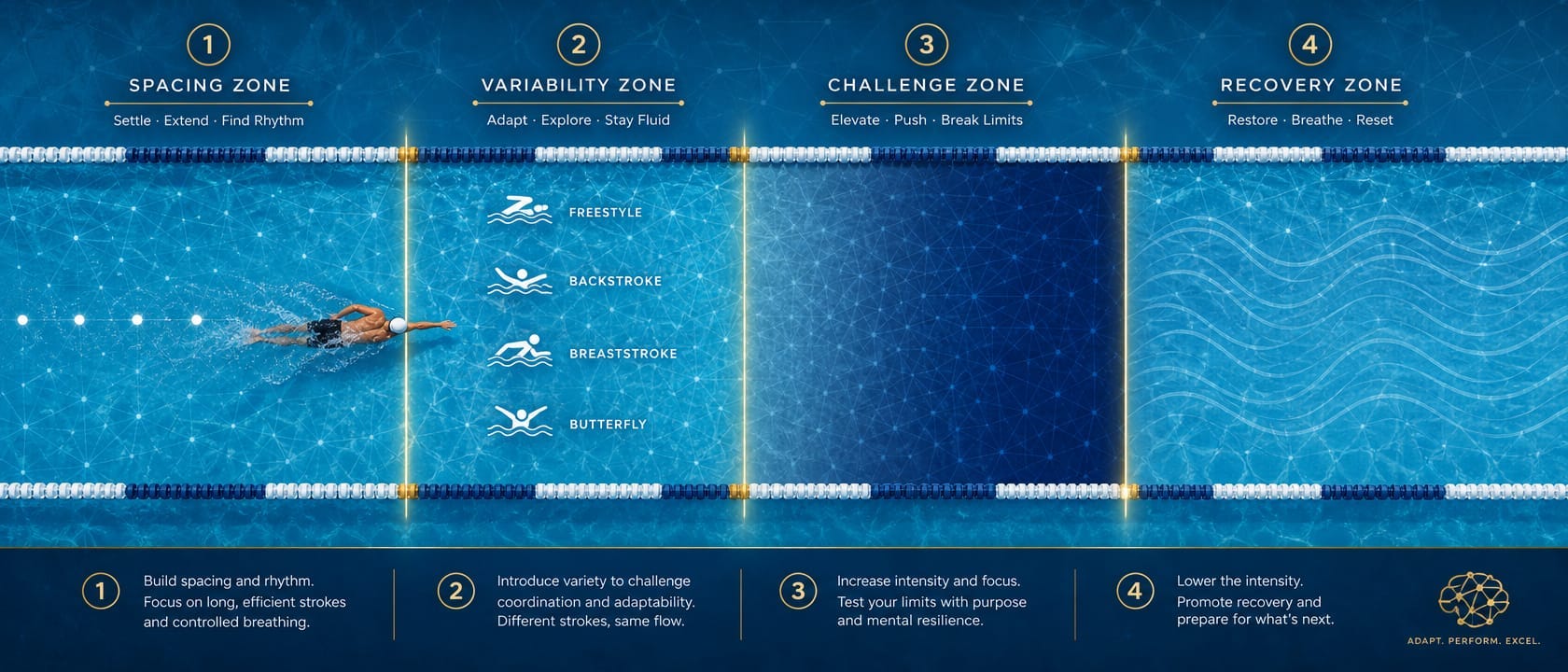
Framework 1: Accelerating Motor Learning
To learn new skills faster:
Pre-practice visualization: Spend 3-5 minutes mentally rehearsing the new skill before physical practice. This primes the motor cortex.
Slow-motion execution: Perform the new skill at 25-50% speed initially. This allows the cerebellum and motor cortex to form accurate error signals. You’re giving them clear information about what the movement should be.
Immediate feedback: Use video or coach feedback within seconds of the attempt. The brain learns best when feedback is temporally close to the movement. Hours later is too late. Right away is best.
Random practice: Mix the new skill with old skills rather than blocking all repetitions together. This looks like it slows initial learning. It actually accelerates retention and transfer. The brain learns deeper when it has to distinguish between contexts.
Sleep on it: Don’t assess a new skill the same day it’s introduced. Allow at least one night of sleep before evaluating progress. Motor memory consolidation happens during sleep. You’ll almost always show improvement overnight.
Framework 2: Avoiding Plateaus and Overtraining
Neural plateaus occur when:
Your practice becomes too repetitive. The brain stops adapting because nothing is new. Vary the stimulus.
Technique errors are allowed to become habits. The basal ganglia encode the wrong pattern. This is hard to undo. Catch errors early.
Mental fatigue accumulates. The prefrontal cortex function degrades. This often looks like irritability, poor focus, and bad decision-making. It’s not a motivation problem.
Sleep is insufficient. Consolidation is impaired. The brain can’t integrate what it learned.
Signs of neural overtraining:
Technical breakdown at moderate intensities. The athlete can’t maintain form because the brain is fatigued.
Increased irritability or emotional lability. The prefrontal cortex is degraded.
Difficulty focusing during sets. Attention is impaired.
Slower reaction times at starts. The motor cortex is sluggish.
Feeling disconnected from the water. Proprioceptive and vestibular processing is degraded.
When you notice these signs:
Insert a “technique deload” week. Reduce volume and increase drill work. Give the brain a break from high-intensity demands.
Change the training stimulus. New drills. Different equipment. Altered pool environment. The brain needs novelty.
Prioritize sleep aggressively. Eight to ten hours for adolescents. This is when consolidation happens.
Reduce cognitive load outside the pool. Manage academic and life stress. The prefrontal cortex has limited capacity.
Framework 3: Using Rest, Sleep, and Recovery for Consolidation
Motor memories aren’t fully formed during practice. They’re stabilized and refined during the hours and days after practice. Sleep plays the critical role.
Slow-wave sleep (deep sleep): Supports consolidation through replay of motor patterns and synaptic homeostasis—a process that both strengthens important connections and prunes weaker ones.
REM sleep: May integrate new motor memories with existing knowledge and support creative problem-solving.
Active recovery: Light aerobic activity increases blood flow and may support the cellular processes of consolidation.
Practical recommendations:
Schedule the most important technique work and race-pace work early in practice, when the brain is fresh, and early in the week when sleep debt is lowest. Don’t save the critical work for Friday afternoon.
Avoid high-intensity cognitive challenges late in the evening when sleep quality may be compromised. If you’re teaching a complex new skill, do it early in the day.
After hard learning sessions, engage in light activity rather than complete sedentary rest. Easy swimming or walking may support consolidation. Sitting on the couch does too, but moving is probably better.
Maintain consistent sleep schedules. Irregular sleep disrupts the circadian regulation of memory consolidation. Same bedtime, same wake time, even on weekends.
Putting it together
You’ve learned about seven brain systems that govern swimming performance. Neuroplasticity allows the nervous system to change. The motor cortex executes commands with precision. The cerebellum manages timing. The basal ganglia automate skills into habits. The prefrontal cortex directs strategy. The sensory systems provide continuous feedback. Brain connectivity integrates all of this into seamless performance.
Elite swimming isn’t a contest of who has the biggest muscles or the largest lungs. It’s a contest of who has trained the most efficient, accurate, and automatic nervous system.
What to do now
For coaches:
Design practices that challenge the brain, not just the body. Embrace variability, spacing, and attentional demands. Teach with an understanding that you’re literally sculpting neural circuits. One more thing: your own brain matters too. Get sleep. Manage stress. The coach’s nervous system affects the team.
For athletes:
Approach practice as neural training. Focus with intention. Embrace the struggle of learning something new. Protect your sleep like it’s a competitive advantage, because it is. Race with the confidence that comes from deeply encoded habits. Trust the system you’ve built in training.
For parents:
Support the long-term development of the whole brain. Value sleep, variety, and patience over early specialization and immediate results. Your kid will develop faster if they sleep more than if they train more. The swimmers who will dominate in the coming decades will be the ones trained smartly—understanding that the pool is where the body works, but the brain is where performance lives.
A closing note
The science here is solid. Neuroplasticity, corticospinal function, cerebellar coordination, basal ganglia habit formation, prefrontal executive function, sensory integration, and neural efficiency- these are well-established principles from neuroscience and motor learning research.
The optimal application of these principles to specific training situations remains evolving. Where evidence is limited and I’ve extrapolated from general motor neuroscience, I’ve noted it. The frameworks here work, but individual athletes and teams will find variations that work better for their specific situation.
That’s expected. That’s where coaching becomes a craft.
The swimmers who will dominate in the coming decades will not just be the ones who train the hardest. They will be the ones who train the smartest-who understand that the pool is where the body works, but the brain is where performance lives.
You’ve reached the end of the Brain-First Swimming series.
Review the complete series:
Your Brain Learns to Swim

The body doesn’t move without the brain telling it to. Every stroke you take starts as an electrical signal in your skull. But most swimming programs pretend the brain isn’t even there. They chase bigger lungs, stronger shoulders, more aerobic capacity. They treat the brain like it’s along for the ride.
The Command Center-Your Motor Cortex Controls Every Stroke

Here’s what’s happening right now as you read this: Your eyes are sending signals about letters on a screen. Your visual cortex is processing them. A fraction of a second later, language centers decode what you’re reading. Motor neurons in your hands might twitch slightly if you’re thinking about swimming. All of this originates in a ridge of brain tiss…
The Timing Computer: Your Cerebellum Keeps You on Rhythm

I’ll tell you something that doesn’t get enough attention: your cerebellum contains about half of all the neurons in your brain, despite being only 10 percent of its volume. It’s packed.
The Autopilot: How Your Basal Ganglia Turn Effort Into Automatic Execution

When you’re first learning freestyle, you have to consciously think about everything. High elbow catch. Body rotation. Kick timing. Breathing coordination. It’s exhausting. You’re monitoring each component, making adjustments, trying to integrate them.
The CEO Brain: Your Prefrontal Cortex Controls Pacing, Decisions, and Mental Toughness

Swimming isn’t just a physical test. It’s a cognitive test.
Body Sense: Why Proprioception and Feeling Are Trainable Skills

Most swimmers can’t actually feel what their body is doing in the water.
The Proprioception Playbook: Drills for Every Stroke

Following up to my previous post - Here is a comprehensive, stroke-specific guide to proprioception drills for swimmers, grounded in motor learning and neuroscience research.
**Next step:** I’m working on a downloadable coaching checklist—one actionable item from each brain system. If you’d like it, reply to this email or leave a comment. I’ll send it out in a few days.
Thank you for reading the entire series. Share it with coaches, swimmers, or parents who might find it useful.
Thank you for putting this together.