
The CEO Brain: Your Prefrontal Cortex Controls Pacing, Decisions, and Mental Toughness
Why mental toughness is actually prefrontal cortex efficiency

Swimming isn’t just a physical test. It’s a cognitive test.
Your prefrontal cortex sits at the front of your frontal lobe, and it runs the show. It holds your race plan in working memory. It decides how fast to go out. It chooses when to accelerate. It interprets signals from your body-your heart rate, your breathing, the burn in your muscles-and decides whether you should maintain effort, increase it, or back off.
When this system is working well, swimmers make good decisions and execute plans. When it’s degraded by fatigue, stress, or sleep loss, swimmers fall apart. They make poor pacing decisions. They break down technically. They choke.
The machinery
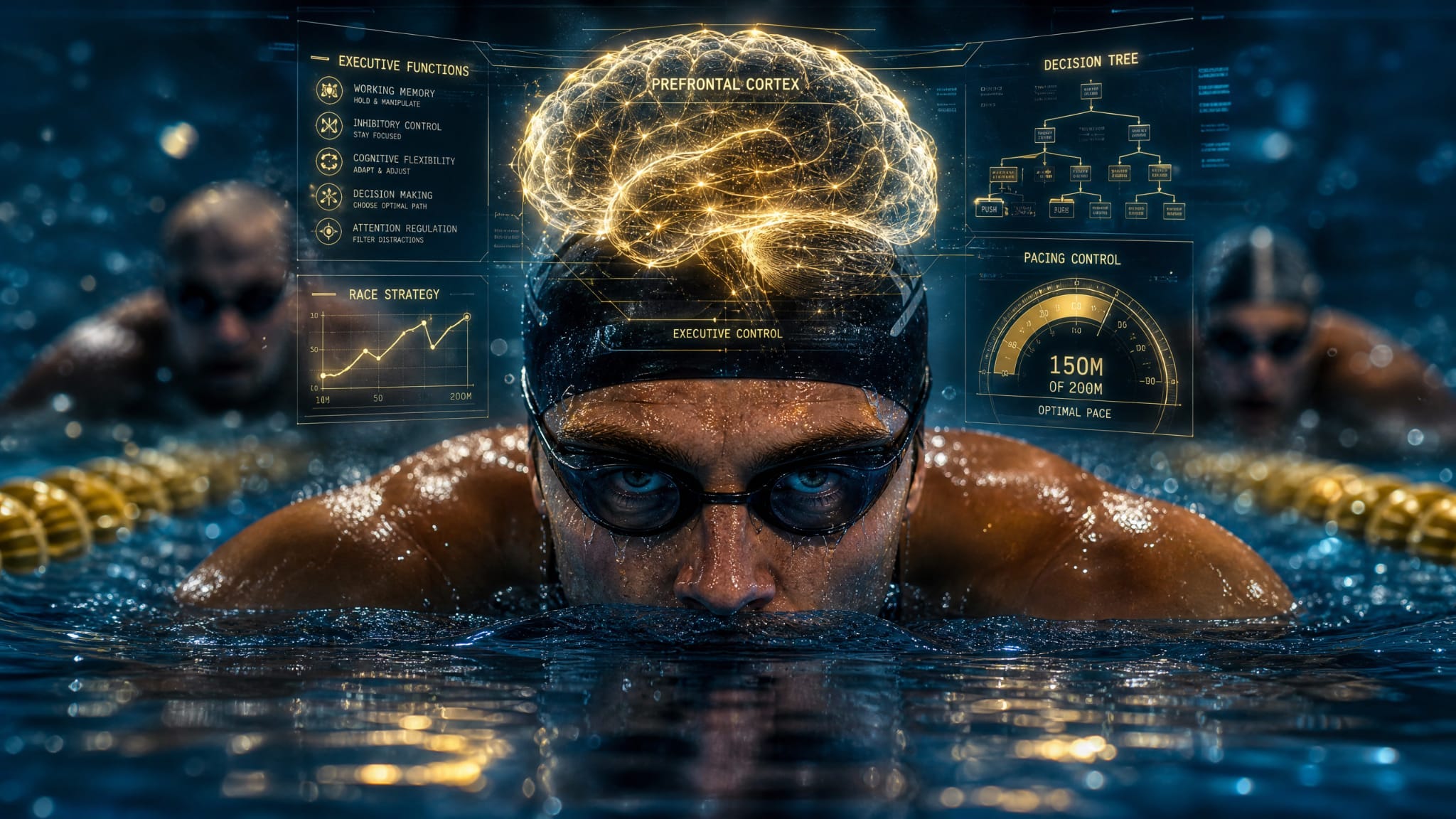
The prefrontal cortex is the seat of executive function. Working memory. Attention. Decision-making. Impulse control. Effort monitoring. It doesn’t directly control muscles. Instead, it modulates activity in the motor cortex, basal ganglia, and other structures deeper in the brain.
The key neurotransmitters are dopamine (reward prediction and motivation), norepinephrine (arousal and attention), and serotonin (mood and impulse control).
One particularly important region is the anterior cingulate cortex, nestled within the prefrontal system. This region monitors conflict and effort. It plays a major role in how hard a task feels. If the anterior cingulate is receiving heavy input about muscle pain or breathing difficulty, you perceive the effort as harder. If your brain interprets the same physiological signals as manageable, the effort feels lighter. This perception is not just psychological. It influences whether you maintain, increase, or decrease effort.
Elite swimmers often show greater effort tolerance. They interpret the same physiological signals- the same heart rate, the same breathing distress, the same muscle burn-as less threatening or more manageable. This is learned. This can be trained.
The prefrontal cortex is highly sensitive to stress, sleep deprivation, and fatigue. All of these degrade its function. This is why sleep matters. This is why managing training stress matters. A degraded prefrontal cortex can’t plan well or execute hard effort efficiently.
What it does in the pool
The prefrontal cortex manages several critical functions during swimming:
Pacing strategy: How fast to go out. When to increase effort. Whether to respond to a competitor’s move. How to distribute energy across a race. This requires holding multiple constraints in mind at once and updating the plan based on how things are unfolding.
Attention control: Maintaining focus on relevant cues—your stroke feel, your race plan—while ignoring distractions. The crowd noise. The competitor next to you. The pain signals. The prefrontal cortex is the neural gatekeeper for attention.
Effort regulation: Interpreting signals from the body and deciding about effort. This is where that anterior cingulate cortex comes in. The same physiological state can feel manageable or catastrophic depending on how your brain interprets it.
Decision-making under pressure: Choosing to respond to a surge. Deciding whether to adjust technique mid-race. Executing a race plan despite unexpected circumstances. This is prefrontal cortex work.
Under extreme fatigue or pressure, prefrontal function can degrade. This is when swimmers make poor pacing decisions, break down technically, and “choke”-fail to execute well-learned skills in high-stakes situations.
The analogy
The prefrontal cortex is the CEO of a company. The CEO doesn’t build the product. The muscles do that. The CEO doesn’t manage the factory floor. The motor cortex and basal ganglia handle that. The CEO sets strategy, allocates resources, monitors performance against goals, and makes critical decisions when problems arise.
When the CEO is tired, stressed, or overwhelmed, the whole company suffers. Even if the factory floor is perfectly capable. Even if the machines are working perfectly. A degraded CEO still makes the organization underperform.
How to train the prefrontal cortex
For coaches
Use cognitive load training sparingly: Some research suggests that practicing under cognitive load—maintaining technique while performing a secondary cognitive task like counting backward—can strengthen prefrontal capacity. But use this sparingly. Chronic cognitive overload can backfire and increase mental fatigue.
Teach explicit race plans: Vague instructions (”swim hard”) create decision fatigue and force the prefrontal cortex to work too hard. Specific plans reduce cognitive load. “Go out in 26.5, build the second 50, attack the third 50, bring it home in 26 flat.” The prefrontal cortex knows exactly what it’s supposed to do.
Simulate pressure in practice: Exposure to pressure situations in training builds prefrontal resilience. Time trials. Mock meets. Consequence-based sets (the team does extra work if someone misses a time). The prefrontal cortex needs to practice maintaining executive function under stress.
For swimmers
Develop a pre-race focus routine: Consistent pre-race routines prime the prefrontal cortex for focused attention. Three deep breaths. A specific visualization. A physical trigger. This reduces anxiety and narrows your focus to what matters.
Use process goals during races: During a race, focus on specific tactical or technical targets: “maintain stroke count,” “attack the third 50,” “focus on the wall.” This keeps the prefrontal cortex engaged productively. Focusing on outcomes (”I must win”) or uncontrollables (”that swimmer is faster”) degrades prefrontal function.
Notice mental fatigue: If you’re making poor decisions, losing focus, or talking to yourself negatively in ways that aren’t typical, your prefrontal cortex may be depleted. This is real fatigue. The solution is sleep and recovery. Pushing through cognitive fatigue just makes things worse.
For parents
Minimize pre-race stress: The prefrontal cortex is exquisitely sensitive to emotional state. Arguments before a race, criticism, excessive pressure—these activate stress circuits that impair executive function. A calm, supportive environment helps the prefrontal cortex work properly.
Help reframe anxiety: Mild pre-race nerves are normal and actually enhance prefrontal arousal and performance. Teach your kid to interpret butterflies as readiness, not fear. The cognitive interpretation of arousal matters. The same physiological state can be anxiety or excitement depending on how you frame it.
One more thing
The prefrontal cortex is also where self-doubt lives. It’s where a swimmer can talk themselves into difficulty or out of effort. This is the mental side of sport. It’s trainable. It responds to exposure, repetition, and success. The more times you execute your race plan under pressure and it works out, the more confident your prefrontal cortex becomes. Confidence isn’t overconfidence. It’s evidence-based. It comes from repetition.
Next week
Week 6: Your sensory systems- proprioception, the vestibular system, and interoception. How your brain senses your body’s position, motion, and internal state. Why this matters more than most people realize.
**Subscribe for the next post in the Brain-First Swimming series.**
Swimmers are smart, because the sport, coaches and athletes choose to stretch their thinking. Great post. Furthermore, the impacts on the head and brain injuries are rare as well.