
The Command Center-Your Motor Cortex Controls Every Stroke
Why sub-maximal training is leaving speed on the table

Here’s what’s happening right now as you read this: Your eyes are sending signals about letters on a screen. Your visual cortex is processing them. A fraction of a second later, language centers decode what you’re reading. Motor neurons in your hands might twitch slightly if you’re thinking about swimming. All of this originates in a ridge of brain tissue in your frontal lobe called the primary motor cortex.
Every stroke, every turn, every movement you execute in the pool begins in this region.
The anatomy
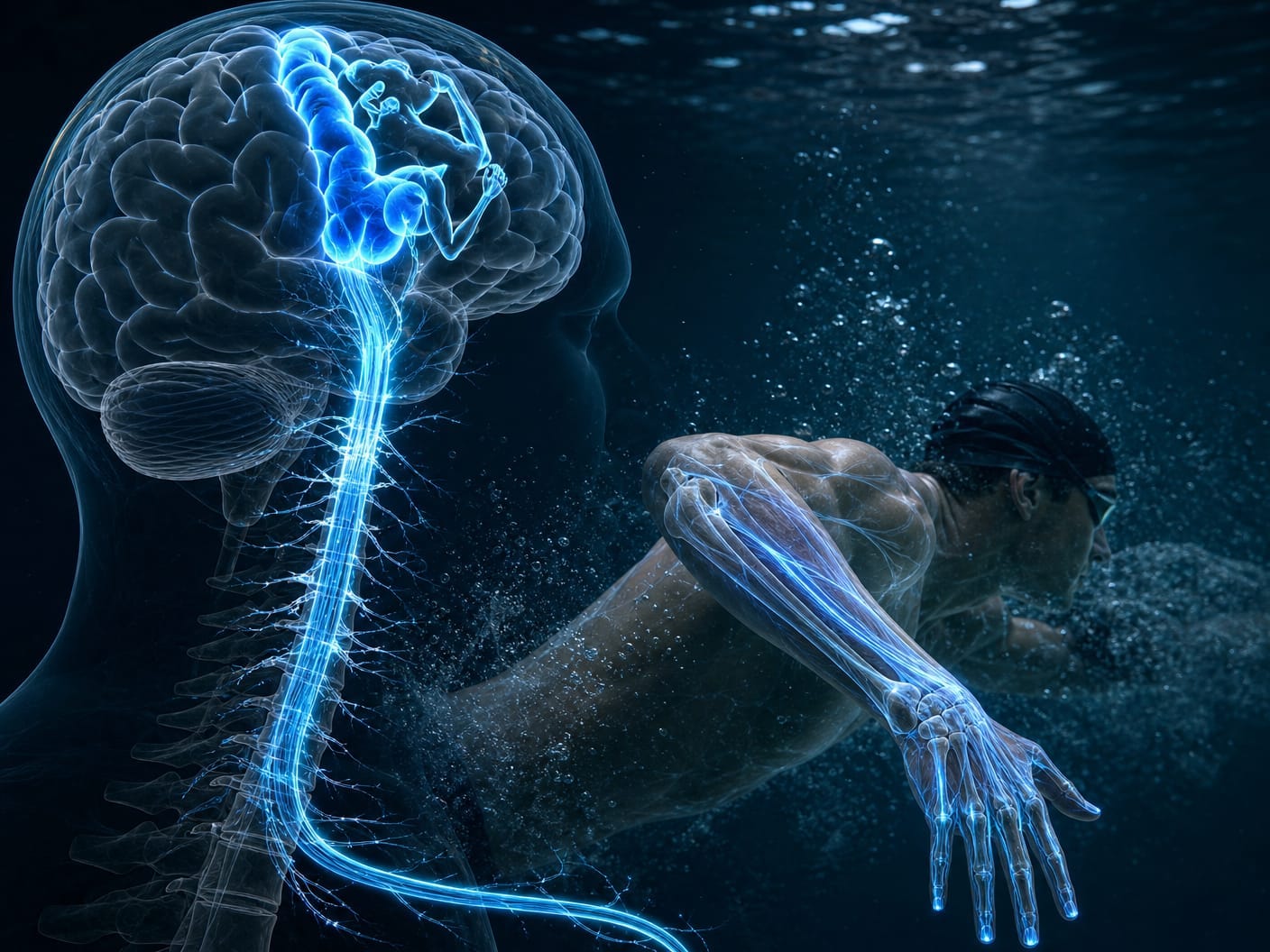
The primary motor cortex sits in a strip running down the back of your frontal lobe. It’s organized as a map of your body-what neuroscientists call a motor homunculus. But it’s not a proportional map. Your hands get a huge amount of cortical real estate because they need fine control. Your face gets more space than your legs. Your trunk gets squeezed into a tiny corner. The brain allocates territory based on how much precision a body part needs, not how big it is.
When you decide to move, neurons in the motor cortex send signals down through the corticospinal tract-a massive cable of axons that runs from your brain down through your brainstem and into your spinal cord. These signals eventually synapse onto motor neurons in your spinal cord, which directly activate your muscles.
How fast these signals travel depends on myelination-the fatty insulation around nerve fibers. Large, well-insulated fibers can carry signals at 100 meters per second. Smaller fibers are much slower. Training can increase myelination, making signals travel faster.
The system also depends on corticospinal excitability-how easily the motor cortex can activate the spinal cord circuits. It depends on motor unit recruitment-your ability to activate exactly the right number and type of muscle fibers for a given movement. The chemicals involved are glutamate (excitatory), GABA (inhibitory-it prevents unwanted movements), and serotonin and norepinephrine (which modulate arousal and readiness).
The anatomy and basic physiology are well-understood. Training does change corticospinal excitability in measurable ways. Most research has focused on other sports (cycling, gymnastics, racket sports), so we’re making some educated guesses about what’s specifically important for elite swimmers.
What this does in the pool
Your motor cortex doesn’t send a generic “move arm” command. It specifies trajectory, force, and timing. In the pool, where there are no fixed reference points and the medium constantly changes, precision matters.
Elite swimmers usually show several patterns at this level:
They have greater corticospinal excitability for their sport-specific movements. Their motor cortex can more readily activate the spinal circuits for trained patterns.
They recruit motor units more efficiently. They can produce the force they need without excessive neural noise-fewer unnecessary signals firing.
They have refined motor maps in M1. The representation of their sport-specific movements is larger and more detailed than in non-athletes.
The analogy
Imagine the motor cortex as the conductor of a symphony orchestra. Each muscle is a musician with a specific score. A beginner’s conductor is uncertain. Musicians play at slightly wrong times. Some play too loud, others too soft. The whole thing is ragged.
An elite swimmer’s conductor has rehearsed the same piece thousands of times. The signals are crisp. The timing is exact. Every musician knows their cue. The orchestra sounds integrated because the conductor’s orders are precise and the system is trained.
The corticospinal tract is the sound system carrying the conductor’s cues to every player.
How to train the motor cortex
For coaches
Use resistance and assistance training: Have swimmers train with parachutes, drag suits, or bands. Assisted swimming with fins or buoyancy aids. Both force the motor cortex to recalibrate. The motor cortex responds to changes in force requirements by refining how it recruits muscles. This variability sharpens the motor map.
Include max-effort sprints: Even for short distances, have swimmers go at absolute maximum effort regularly. This trains the motor cortex to recruit motor units more completely. Swimming at 90% effort doesn’t produce the same neural adaptation as swimming at 100%.
Give athletes external focus cues: Tell them to “push the water back” rather than “bend your elbow.” Research shows that directing attention to the effect of the movement-rather than the mechanics of the body-produces more efficient learning and better motor cortex activation. The outcome focus is what matters, not the body position.
For swimmers
Maintain intent to move fast: Even during technique work, keep the intention of speed. The motor cortex responds to movement intention, not just actual speed. You can swim slowly with fast intent, and this is actually useful—it trains the motor cortex to execute at high intensity without the metabolic cost of full speed. This is a real technique, though direct evidence specific to swimming is limited.
Use contrast sets: Swim hard resistance, then switch to normal swimming. The contrast can increase power output in the normal swims through neural changes. Your motor cortex has recalibrated to the higher force requirements, and when the resistance drops, it keeps recruiting muscles hard.
Eliminate unnecessary tension: A clenched jaw or tight shoulders during freestyle means your motor cortex isn’t doing good inhibitory control. You’re activating muscles you don’t need. Train yourself to relax non-prime movers. This is harder than it sounds. It requires specific attention, but it matters for efficiency.
For parents
Multi-sport in the early years matters: Different sports develop different motor maps. A kid who only swims has a narrow neural foundation. Multi-sport kids often show better coordination and pick up new skills faster when they do specialize. It’s not just variety. It’s building a more robust motor cortex.
A technical note
One thing that sometimes surprises coaches: the motor cortex adapts quickly to training but is also sensitive to sleep loss, stress, and overtraining. A swimmer who hasn’t slept well will have degraded corticospinal excitability. You might schedule perfect training, but if your athlete is exhausted, the neural adaptation won’t happen the same way.
Next week
Week 3 covers the cerebellum- your brain’s timing computer. The system that coordinates your arms, legs, core, and breathing with millisecond precision while your body is suspended in a fluid with constantly changing resistance.
**Subscribe for the next post in the Brain-First Swimming series.**