
POST 2: The Midjourney Scanner vs. Your Swimming Toolkit - What It Can and Cannot Do
A direct comparison to DXA, Bod Pod, MRI, skinfolds, and everything else you already use

Introduction
In Post 1, we broke down the physics: the Midjourney Scanner is ultrasound at 1 MHz, limited to 15-25 mm resolution, unable to see through bone or air, and marketed with claims that violate the wave equation.
But what does that actually mean for your swimmers? For your budget? For the parent asking whether this replaces the DXA you scheduled for next month?
This post compares the Midjourney Scanner directly to every tool you currently use in elite swimming. No hype. No marketing. Just physics and validation.
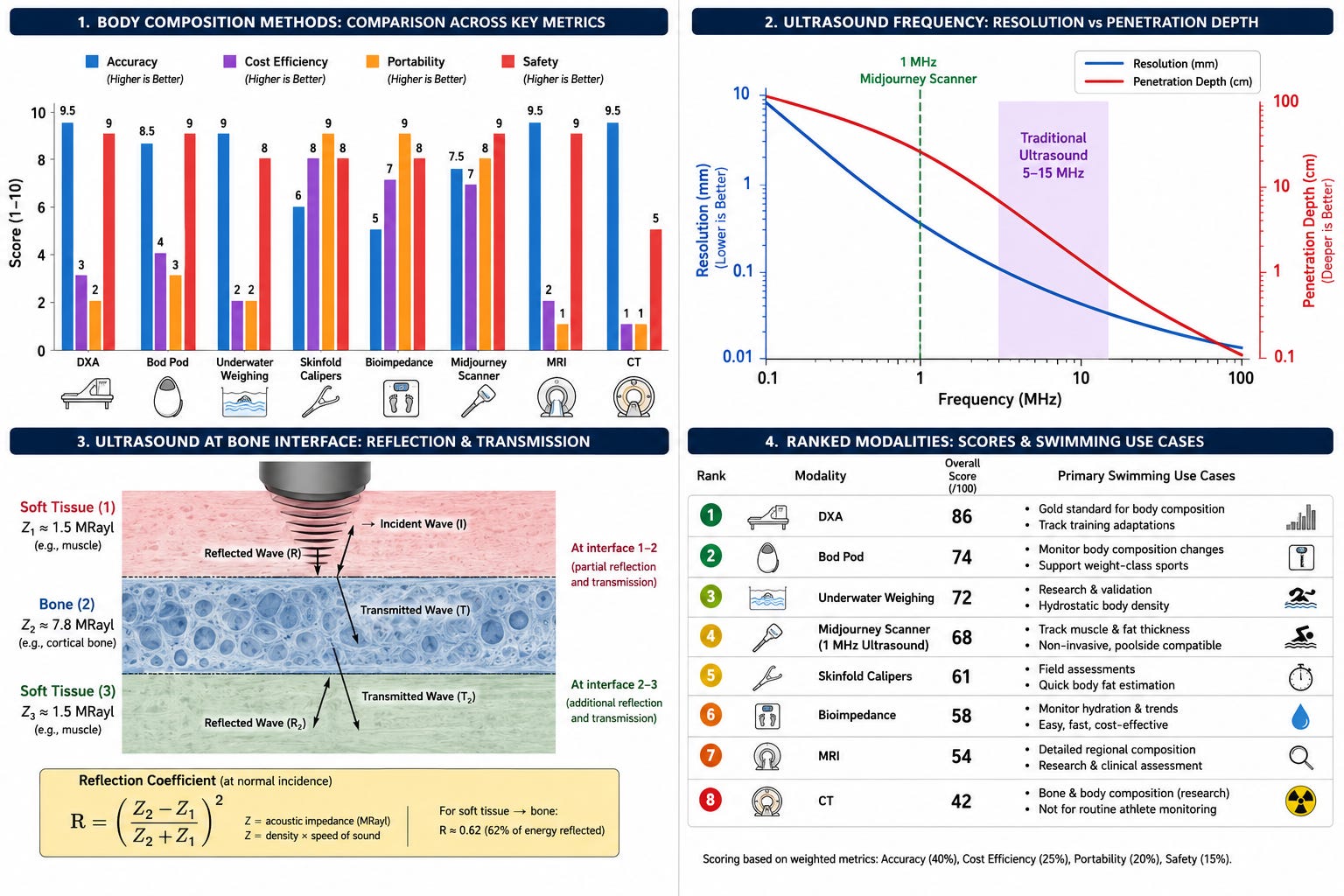
The Complete Elite Swimming Imaging Arsenal
DXA (Dual-Energy X-Ray Absorptiometry)
Physics: Two X-ray beams at different energies. Differential attenuation separates bone mineral, lean tissue, and fat mass.
What it measures: Body fat %, lean mass by region (arms, legs, trunk), bone mineral density (BMD), visceral adipose tissue.
Resolution: 0.5 mm
Safety: Low-dose ionizing radiation (1-10 μSv, comparable to a cross-country flight)
Speed: 10 minutes
Cost: High (50,000-100,000 machine, 100-300 per scan)
Swimming use: Gold standard for body composition. Used at NCAA championships, Olympic training camps, national team screenings. Tracks seasonal changes. Critical for identifying RED-S (Relative Energy Deficiency in Sport).
Comparison to Midjourney: DXA is validated, quantitative, FDA-cleared, and 30-50× more precise. Midjourney cannot distinguish muscle from fat at the tissue level. Holz’s “body composition maps” are wellness claims, not medical measurements.
Verdict: Midjourney does NOT replace DXA.
Bod Pod (Air Displacement Plethysmography)
Physics: Measures body volume by air displacement. Body density = mass/volume. Fat % derived via Siri or Brozek equations.
What it measures: Body volume, body density, estimated body fat %.
Resolution: 1-2% body fat accuracy
Safety: Non-invasive, no radiation
Speed: 5 minutes
Cost: Medium (30,000-50,000 machine)
Swimming use: NCAA standard for pre/post-season body composition. Quick, repeatable, comfortable for athletes. Less accurate than DXA for very lean athletes (swimmers often <10% body fat).
Comparison to Midjourney: Bod Pod gives a single validated number with known accuracy. Midjourney gives cross-sectional images at 15-25 mm resolution—too coarse to quantify body fat % accurately. Bod Pod is FDA-cleared. Midjourney’s wellness exemption means no validation requirement.
Verdict: Midjourney does NOT replace Bod Pod.
Underwater Weighing (Hydrostatic Weighing)
Physics: Archimedes’ principle. Body volume = weight in air - weight underwater / water density.
What it measures: Body density, estimated body fat %.
Resolution: 1-2% body fat accuracy
Safety: Non-invasive. Drowning risk if athlete panics (rare).
Speed: 20 minutes
Cost: Low (5,000-15,000)
Swimming use: Historical gold standard. Still used in research labs. Swimmers are good at maximal exhalation underwater- something swimmers are actually good at.
Error sources: residual lung volume, gastrointestinal gas.
Comparison to Midjourney: Underwater weighing is density-based with decades of validation. Midjourney is imaging with no published validation. They measure completely different things.
Verdict: Midjourney does NOT replace underwater weighing.
Skinfold Calipers
Physics: Mechanical compression of subcutaneous fat at standardized sites (7 or 9 sites).
What it measures: Subcutaneous fat thickness. Converted to body fat % via Jackson-Pollock equations.
Resolution: 1-2 mm (thickness measurement)
Safety: Non-invasive. Operator-dependent (inter-rater reliability is the main issue).
Speed: 5 minutes
Cost: Very Low (200-500)
Swimming use: Daily or weekly team monitoring. Portable. Done at the pool. Tracks subcutaneous fat distribution (triceps, suprailiac, abdominal). Critical for detecting rapid weight loss.
Comparison to Midjourney: Skinfolds measure subcutaneous fat at specific sites with 1-2 mm precision. Midjourney cannot resolve subcutaneous fat layers at 15-25 mm resolution. And skinfolds are validated against hydrostatic weighing and DXA.
Verdict: Midjourney does NOT replace skinfold calipers.
Bioimpedance Analysis (BIA)
Physics: Passes a small AC electrical current (50-100 kHz) through the body. Measures impedance (resistance + reactance). Lean tissue (water, electrolytes) conducts electricity; fat tissue resists it.
What it measures: Total body water, estimated fat-free mass, estimated body fat %.
Resolution: 2-3% body fat accuracy
Safety: Non-invasive. No radiation.
Speed: 30 seconds
Cost: Very Low (100-2,000)
Swimming use: Home and field quick checks. Portable scales and handheld devices.
Major limitation: Extremely sensitive to hydration status. A swimmer 2% dehydrated shows as 2% higher body fat. Useless for same-day pre/post-practice comparisons.
Comparison to Midjourney: BIA gives a single number in 30 seconds. Midjourney takes 60 seconds and produces images. BIA is more accurate for body fat estimation; Midjourney gives spatial distribution (but at very low resolution). BIA devices are FDA-cleared. Midjourney’s wellness device is not.
Verdict: Midjourney does NOT replace BIA.
MRI (Magnetic Resonance Imaging)
Physics: Strong magnetic field (1.5-3 Tesla) aligns hydrogen protons. RF pulses perturb alignment. Signal from T1/T2 relaxation.
What it measures: Muscle volume, intramuscular fat, tendon quality, bone marrow edema, cartilage, labral tears, rotator cuff pathology, stress reactions.
Resolution: 0.5-1 mm
Safety: No ionizing radiation. Risks: magnetic projectiles, RF heating, claustrophobia.
Speed: 15-90 minutes for full body
Cost: Very High (1-3 million machine, 1,000-3,000 per scan)
Swimming use: Injury diagnosis (shoulder impingement, labral tears, tendinopathy). Muscle quality assessment (intramuscular adipose infiltration). Bone marrow edema (early stress injury). Research on muscle architecture (fascicle length, pennation angle).
Comparison to Midjourney: MRI sees through bone, images air-filled lungs (with sequences), and resolves individual muscle fascicles. Midjourney cannot do any of these. Holz’s claim of “MRI-comparable” is physically impossible at 1 MHz.
Verdict: Midjourney does NOT replace MRI.
CT Scan (Computed Tomography)
Physics: Rotating X-ray tube + detector array. Measures attenuation from multiple angles.
What it measures: Bone stress fractures, visceral fat, anatomical detail, calcifications.
Resolution: 0.5 mm isotropic
Safety: Ionizing radiation (100-1,000× a single X-ray for full body). Cumulative dose concerns.
Speed: Seconds
Cost: Very High (1-2 million machine, 500-2,000 per scan)
Swimming use: Medical diagnosis only. Detects bone stress fractures (e.g., ribs). Not used for routine body composition due to radiation. Visceral fat quantification in research.
Comparison to Midjourney: CT has no acoustic shadowing. It sees bone, air, and everything between. Resolution is 30-50× better. But it uses ionizing radiation. Midjourney is radiation-free but blind to bone and air.
Verdict: Midjourney does NOT replace CT.
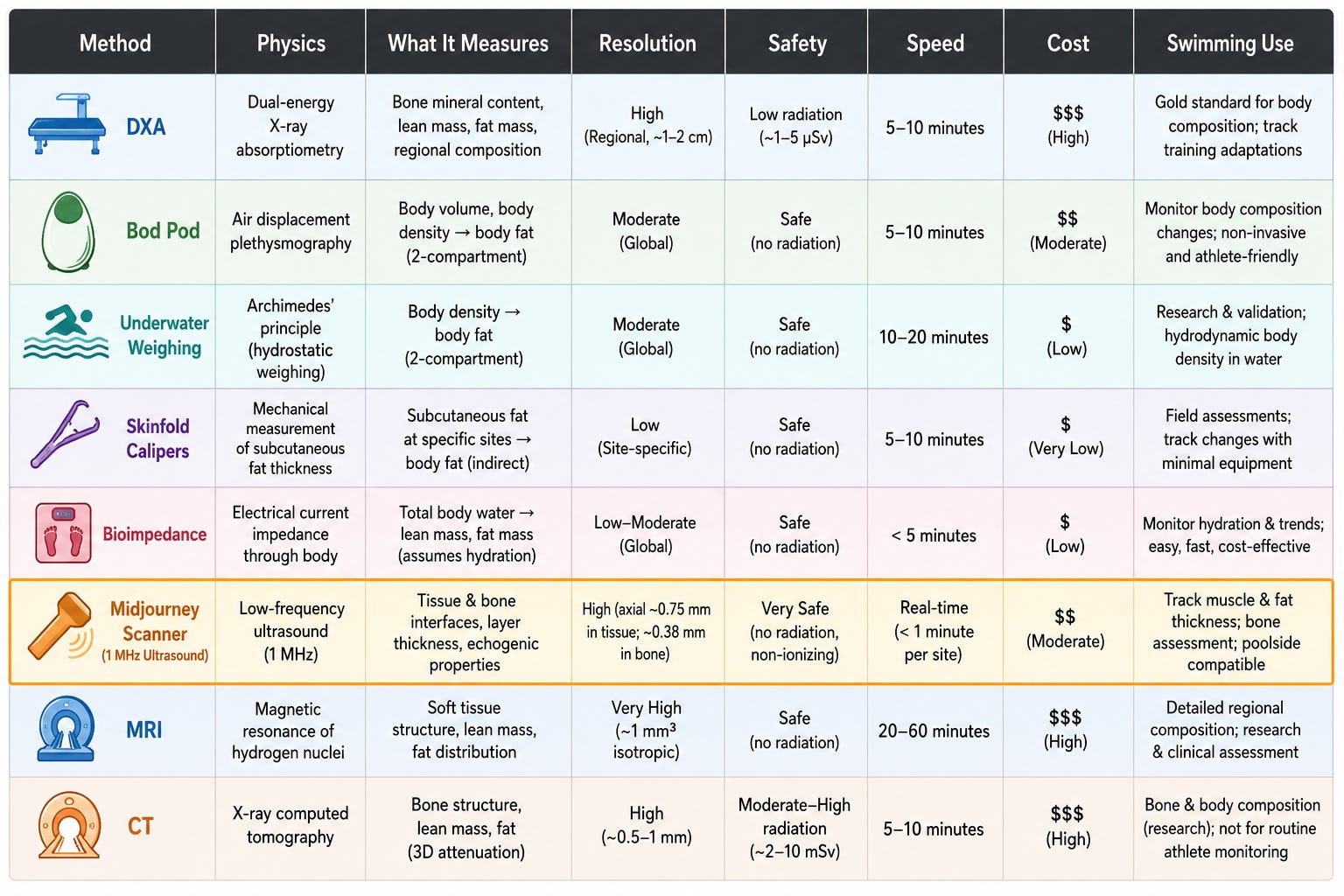
The Midjourney Scanner
Physics: Acoustic waves (1 MHz) in water immersion. 40 Butterfly modules. FWI and AI reconstruction.
What it measures: Cross-sectional area, tissue distribution (muscle vs. fat at very coarse resolution), body shape.
Resolution: 15-25 mm (elevational), 1.5-3 mm (axial, best case)
Safety: No ionizing radiation. Thermal and cavitation limits apply.
Speed: 60 seconds
Cost: TBD (spa model, 10% of MRI = 100-300 per scan)
Swimming use: NOT validated for athletic body composition. Could potentially track large-scale body shape changes over time. No peer-reviewed validation. No FDA clearance.
Comparison to existing tools: Does not replace any current modality. Might add a novel (low-resolution) body shape tracking tool-if validated.
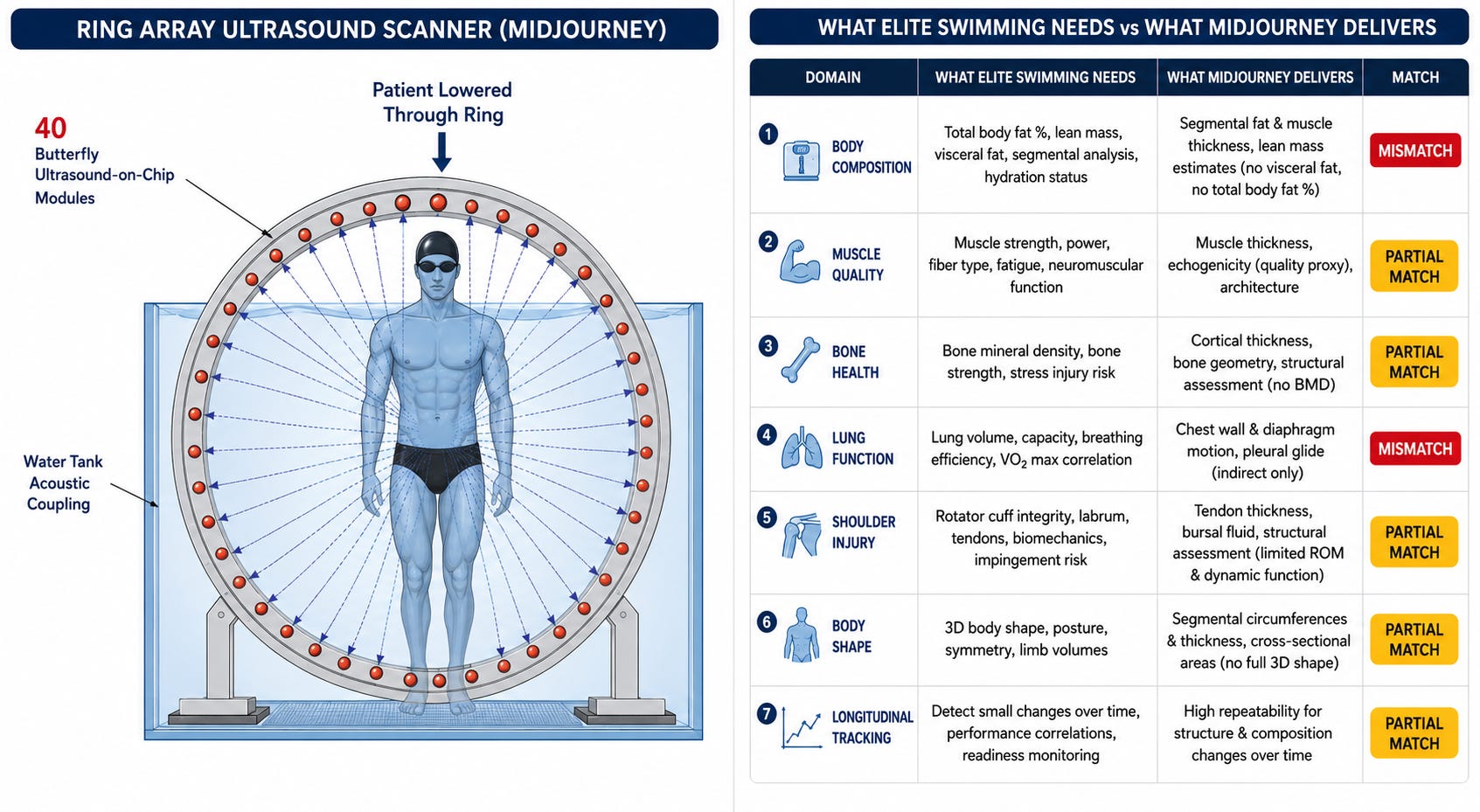
The Seven Questions Every Coach Should Ask
When evaluating any new technology:
What physics does it use? Ultrasound, X-ray, MRI, or electrical impedance?
What is the fundamental resolution limit? This cannot be overcome by software.
What are the hard physical barriers? Bone, air, distance, signal attenuation?
What is it validated against? DXA? Hydrostatic weighing? Cadaver studies?
What is the regulatory status? Medical device or wellness gadget?
What does it cost per scan? Including staff time, interpretation, repeatability?
What do independent experts say? Radiologists, physicists, sports scientists?
The Midjourney Scanner answers:
Ultrasound (acoustic waves)
15-25 mm (at 1 MHz)
Bone and air (acoustic shadowing)
Nothing yet (no published validation)
Spa/wellness (not a medical device)
Unknown (likely subscription, 100-300 target)
Mixed to negative (radiologists skeptical, physicists critical)
What It Might Actually Be Good For
Despite the limitations, there are legitimate applications:
Body shape visualization: Cross-sectional area at waist, hips, shoulders. Could track torso shape changes over a training cycle.
Adipose tissue distribution: Large-scale fat depot mapping (if validated against DXA).
Longitudinal monitoring: Fast, repeatable, no radiation. Could track seasonal changes-if validated.
Athlete engagement: Visual feedback can motivate. Seeing a “scan” may improve nutrition compliance.
Drag coefficient estimation: Cross-sectional area data could feed into CFD models.
But every single one of these requires validation. Without comparison to DXA, you don’t know if the “body composition map” is accurate, precise, or clinically meaningful.
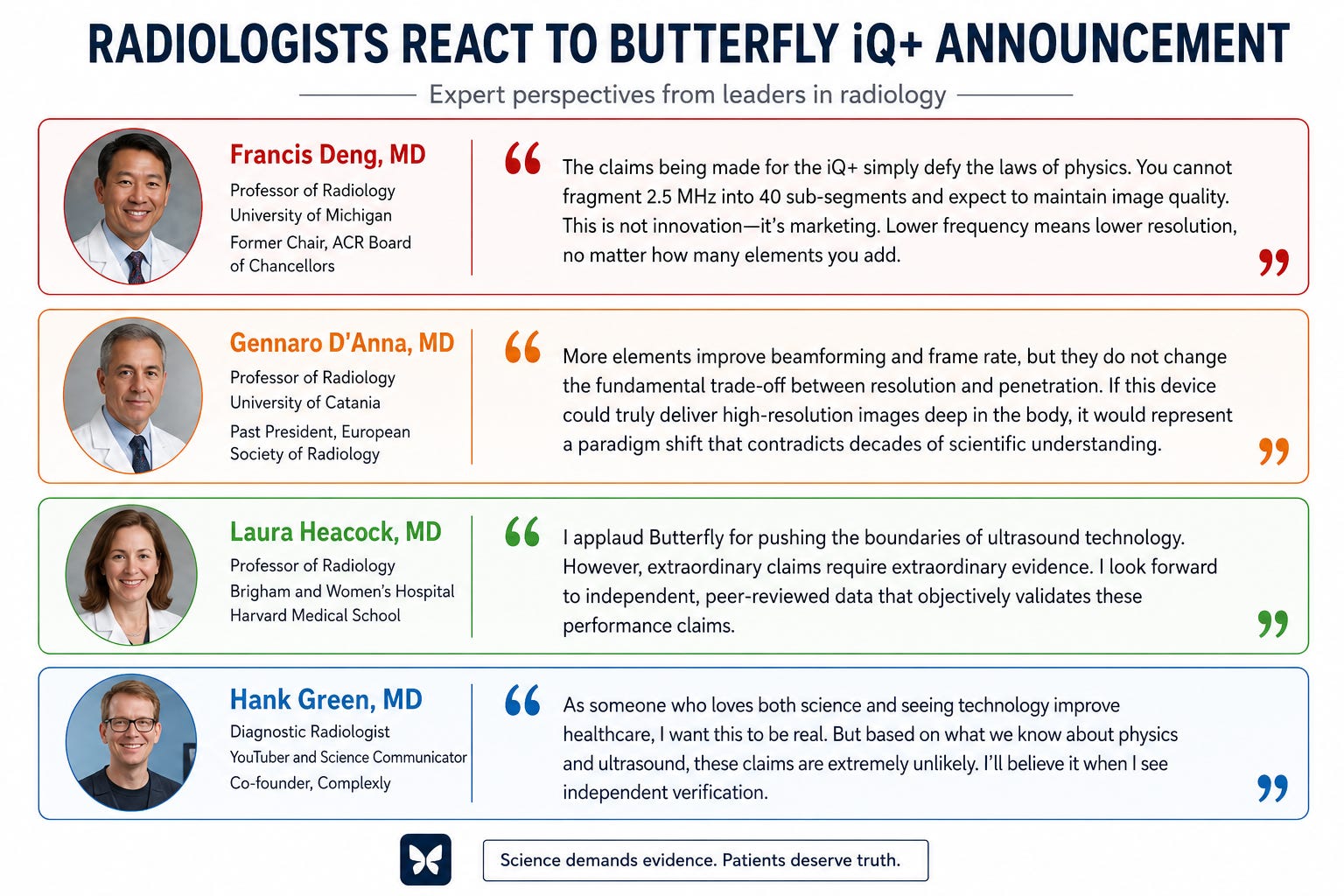
What It Will Never Do
Replace DXA : DXA is validated, quantitative, FDA-cleared, and 30-50× more precise.
Replace MRI: MRI sees through bone, images tendons, detects edema.
Replace CT : CT detects stress fractures.
Image lungs or brain : Physics makes this impossible at 1 MHz.
Detect small tumors or lesions : 15-25 mm resolution misses most early pathology.
6. Provide validated body composition : Wellness device status means no validation requirement.
Avoid 30% of deaths : No evidence supports this claim.
The Bottom Line for Swimming
The Midjourney Scanner does not replace any tool in your current toolkit. It might-if validated-add a low-resolution body shape visualization modality. But at 15-25 mm resolution, it cannot distinguish your latissimus dorsi from your subcutaneous fat layer. It cannot see through your scapula to image your rotator cuff. It cannot measure your bone density or detect a stress fracture.
The spa concept is clever business strategy. It is not sports science.
Physics doesn’t care about marketing. And neither should you.